

Custom Race Suits — Materials
Cowhide, Kangaroo, or Hybrid: Choosing Leather for Your Race Suit
Kangaroo leather's strength-to-weight advantage over cowhide comes from a genuinely different fibre structure, not marketing, and published research explains why. This guide sets out what that structural difference actually means for a race suit, and when the extra cost of kangaroo or a hybrid build is worth it.
By NFmoto Technical Team · Last updated 22 July 2026 · 5 min read
Cowhide and kangaroo leather are both genuine, well-proven materials for race suits, and the choice between them is a real trade-off rather than one being simply "better." The performance difference has a documented structural explanation, not just anecdote, and understanding it makes the cost-versus-benefit decision considerably clearer.
Cowhide: The Proven Standard
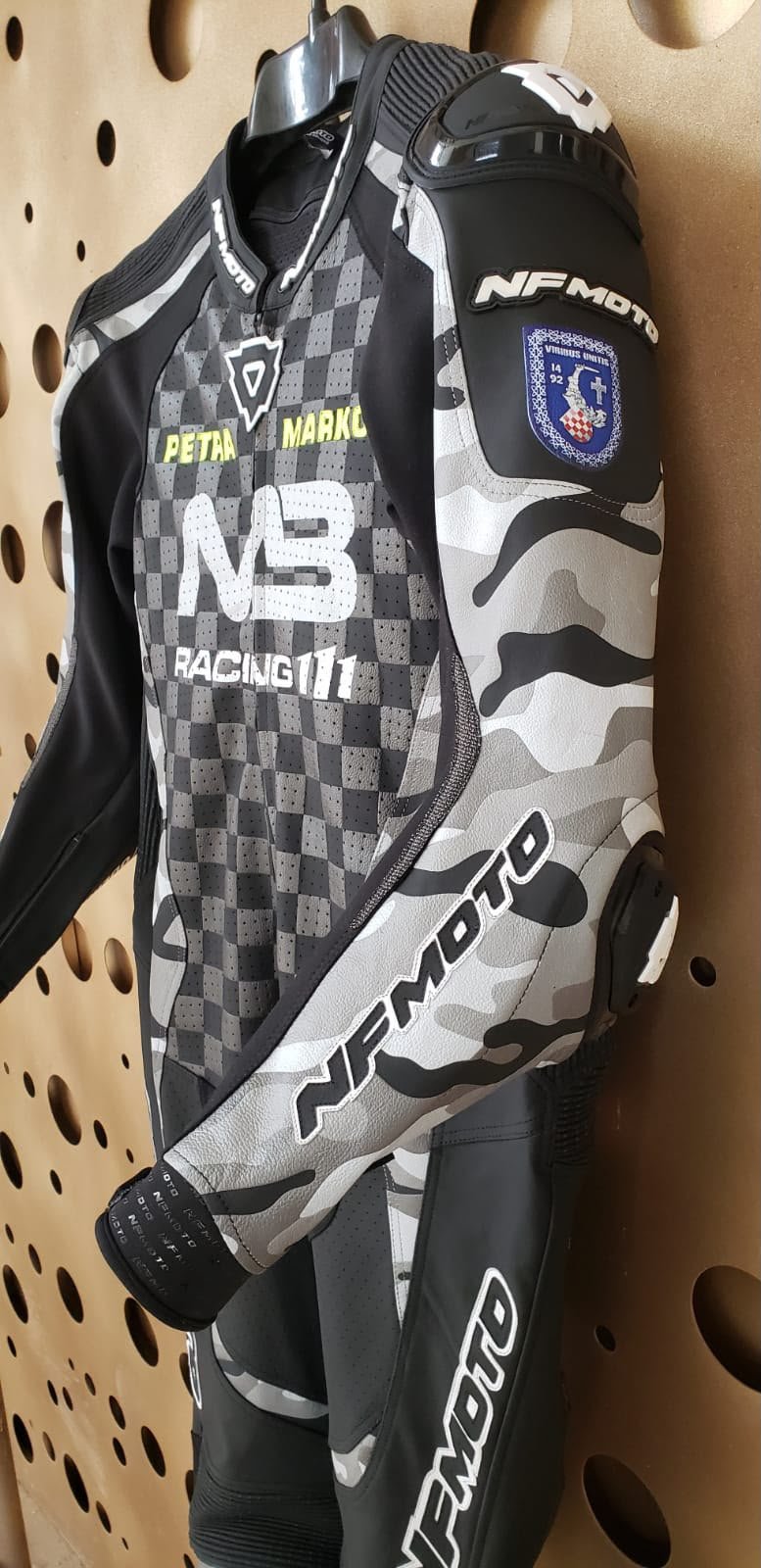
Cowhide has been the standard material for motorcycle race suits for decades, and remains the default choice across most of the market for good reason. NFmoto's standard build uses full-grain cowhide around 1.3mm thick, double-layered at primary impact zones, which provides strong, well-understood abrasion resistance at a sensible weight. Cowhide's strength comes largely from its density and thickness rather than an unusually efficient fibre structure. It does the job reliably, at a lower cost than kangaroo, and with decades of real-world use behind it in racing and trackday conditions.
NFmoto's standard build: 1.3mm full-grain cowhide, double-layered at primary impact zones.
Kangaroo: Why It's Actually Different
Kangaroo leather's reputation as a premium race suit material isn't simply marketing repeated often enough to become accepted wisdom. Published research into the comparative structure of kangaroo and cattle hide (Stephens, 1987; Bavinton et al., 1987) found a genuine structural difference: kangaroo leather's collagen fibre bundles run in a highly uniform orientation parallel to the skin surface, and the hide lacks the sweat glands and erector pili muscles that interrupt the fibre structure of cattle hide. Cattle hide's fibre bundles, by contrast, run at angles as steep as 90 degrees to the skin surface in a more complex cross-section, which creates more potential weak points through the material.
This structural uniformity is why kangaroo leather retains a disproportionate amount of its tensile strength even when split to a thinner gauge. The same research found kangaroo leather split to 20% of its original thickness retains 30–60% of the unsplit hide's tensile strength, compared to just 1–4% for calf leather split to the same proportion. In practical terms, this means kangaroo leather can be used at a meaningfully thinner gauge than cowhide while matching or exceeding its abrasion resistance, which is the entire basis of its weight advantage in a finished suit.
Split to 20% of its original thickness, kangaroo leather retains 30–60% of its tensile strength — calf leather retains just 1–4% at the same proportion.
See the real range at 20% split thickness
Figures are the real range reported by Stephens (1987) and Bavinton et al. (1987) for hide split to 20% of its original thickness — not a continuous formula, illustrative of the two real endpoints stated in the research.
What the Weight Difference Actually Means
A lighter suit isn't simply more comfortable to wear. It reduces rider fatigue over a race distance or a full trackday, and every gram removed from the suit is a gram that doesn't need to be managed through body position and muscle effort at speed. For riders and racers where marginal performance gains matter, this is a genuine, measurable benefit rather than a subjective one. For a rider doing occasional trackdays where fatigue over a session isn't a limiting factor, the weight difference is real but less likely to be the deciding factor in the leather choice.
The Hybrid Option
A hybrid build (kangaroo leather at the primary impact zones such as shoulders, elbows, hips, and knees, with cowhide elsewhere) is a genuine middle option, not a compromise dressed up as one. It concentrates the material cost of kangaroo where abrasion resistance and weight saving matter most during a slide, while using the more cost-effective cowhide across larger panel areas where the structural advantage matters less. For riders weighing the full cost of an all-kangaroo build against a straightforward cowhide suit, a hybrid construction is worth discussing directly, since it can capture a meaningful portion of kangaroo's benefit without the full cost premium.
How They Look and Feel
Beyond the technical properties, cowhide and kangaroo leather have genuinely different tactile characteristics that some riders factor into the decision alongside performance. Cowhide has a firmer, more substantial hand-feel, which some riders associate with a reassuring sense of robustness even though thickness alone doesn't determine protective performance. Kangaroo leather is noticeably softer and more supple from the outset, requiring less break-in time to move and flex naturally with the body. A new cowhide suit typically needs more wear before it fully conforms to the rider's movement, while kangaroo reaches that point faster.
Visually, the two leathers can be finished to look very similar once dyed and worked into a panel, so the practical difference is felt more than seen once a suit is complete. Riders who've worn both consistently describe kangaroo as feeling closer to a "second skin" once broken in, which for some is worth the cost premium on its own, independent of the abrasion and weight arguments.
At a Glance
| Cowhide | Kangaroo | Hybrid | |
|---|---|---|---|
| Weight | Heavier | Lighter at equivalent protection | Partial weight saving |
| Cost | Lower | Real premium | Between the two |
| Break-in feel | Firmer, needs more wear | Softer and supple from the outset | Mixed, by panel |
| Best suited to | Occasional trackdays, fixed budget | Regular racing, marginal gains matter | Wanting some of kangaroo's benefit at lower cost |
A Practical Way to Decide
For a rider trying to choose between the three options, a few honest questions help narrow it down. How often is the suit likely to be used, and at what level: occasional trackdays, or regular racing where marginal weight and fatigue gains compound over a season? Is budget a hard constraint, or is the decision purely about getting the best possible material regardless of cost? And does the rider have a strong preference for how the leather feels once broken in, independent of the abrasion-resistance argument?
A rider doing occasional trackdays on a fixed budget is well served by a straightforward cowhide build. It's proven, cost-effective, and the weight difference is unlikely to be the limiting factor in their riding. A rider racing regularly, where every gram and every degree of unrestricted movement compounds over a season, has a stronger case for kangaroo or a hybrid build concentrating it at the primary impact zones. There's no universally correct answer, only a correct answer for a specific rider's usage and budget, which is exactly the kind of decision worth talking through directly before committing to a spec.
Cost, Care, and the Honest Trade-Off
Kangaroo leather carries a real cost premium over cowhide, reflecting both the material's sourcing and the structural properties described above. It also asks for more careful maintenance. Like all leather, it should be cleaned with cool, clear water rather than solvent-based products, and general handling care matters more given the material's cost. Cowhide is the more forgiving, lower-maintenance, lower-cost choice, and remains a completely sound one: the majority of race suits sold and raced in are cowhide, and a well-built cowhide suit performs reliably.
Neither material is objectively correct for every rider. The honest framing is that cowhide is the proven, cost-effective, widely used default; kangaroo trades a real cost premium for a genuine, structurally-explained weight and thinness advantage; and a hybrid build is a legitimate way to capture part of that advantage without committing to the full cost of an all-kangaroo suit. On long-term durability, both materials hold up well over years of correct use and storage. The more common cause of premature leather failure in either material is poor storage (damp conditions, prolonged folding) or improper cleaning, rather than any inherent shortcoming in the leather itself.
Common Questions
Is kangaroo leather actually stronger than cowhide, or is that just marketing?
How much thinner can kangaroo leather be while matching cowhide's protection?
What's NFmoto's standard leather thickness?
Does kangaroo leather need different care than cowhide?
Is a hybrid build worth the extra cost over all-cowhide?
Should I choose kangaroo if I only do occasional trackdays?
Continue Reading
Ready to Start Your Order?
Download our measurement templates or get in touch to talk through your build before you order.